Lyophilized
Store at -20°C for optimal long-term stability (up to 2 years). The lyophilized form is stable at room temperature for brief periods during shipping and handling.
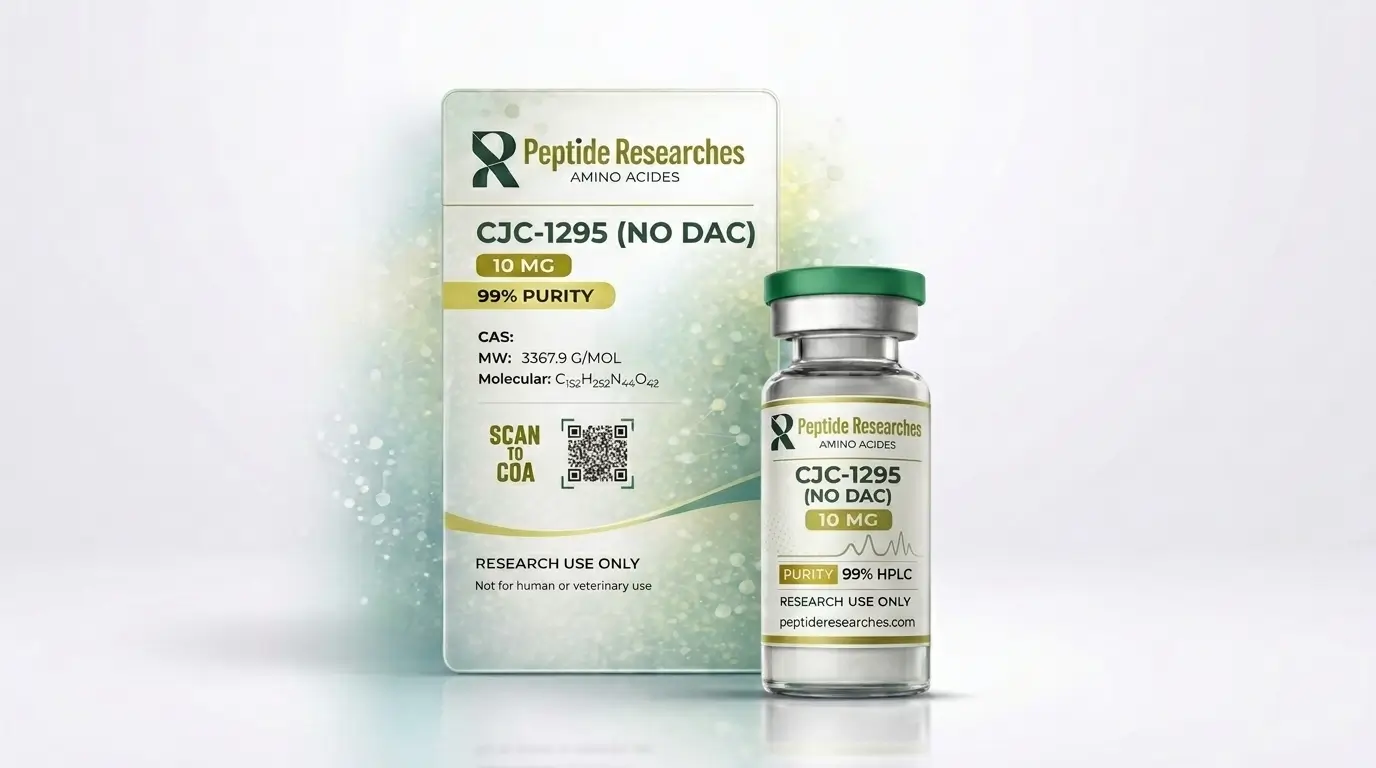
CJC-1295 No DAC 10 MG by Peptide Researches displayed with the product box, QR code, purity information, and labeled vial.
CJC-1295 without DAC is a research-grade, lyophilized peptide supplied for controlled laboratory studies involving GHRH-related receptor signaling, assay development, and peptide characterization. Lot-specific COA access and supporting analytical documentation are available through the COA portal. For laboratory research use only. Not for use in humans or animals.
All Peptide Researches compounds are supplied strictly for in-vitro research use only. Each batch is tested using High-Performance Liquid Chromatography (HPLC) and Mass Spectrometry (MS), with typical purity ≥ 99% as documented in the accompanying COA.
CJC-1295 without DAC is a research-grade, lyophilized peptide supplied for controlled laboratory workflows such as assay development, analytical verification, and peptide characterization. This material is commonly referenced in research settings for GHRH-related receptor signaling studies and comparative pathway readout work under validated laboratory conditions.
Each batch is supported by lot-specific documentation to assist with traceability and experimental recordkeeping. Available records may include Certificate of Analysis data and analytical review files, including HPLC and MS, when released for the batch through the COA portal.
This product is intended for laboratory research environments that require clearly documented peptide material, purity review, and standardized handling context. For laboratory research use only. Not for use in humans or animals. Not intended to diagnose, treat, cure, or prevent any disease.
Purity (HPLC) | ≥99% |
Appearance | White to off-white lyophilized powder |
Material Type | Research-grade |
Molecular Formula | C₁₅₂H₂₅₂N₄₄O₄₂ |
Molecular Weight | 3367.9 g/mol |
CAS Number | 446036-97-1 |
Net Content | Varies by selected variant (choose mg option) |
Solubility | See laboratory SOP (solvent selection depends on assay requirements) |
Storage (Lyophilized) | Store protected from light and moisture; follow institutional SOPs |
Storage (Prepared for assays) | Aliquot as needed; avoid repeated freeze–thaw; follow institutional SOPs |
Intended Use | For research use only; not for human or veterinary use |
Documentation | Lot-specific COA; analytical data (HPLC/MS) when available |
CJC-1295 without DAC is commonly listed in supplier and reference materials as CJC-1295 No DAC, Mod GRF 1-29, or Modified GRF 1-29. It is described as a 29-amino-acid synthetic peptide analog derived from the active N-terminal region of growth hormone-releasing hormone, with a reported molecular formula of C152H252N44O42 and a molecular weight of 3367.9 g/mol. Core Peptides also lists the material as lyophilized powder with purity above 99%, which matches the general specification style used across research-focused product pages.
Research references and supplier pages describe CJC-1295 without DAC as a tetra-substituted GRF 1-29 analog. The commonly cited substitutions are D-Ala at position 2, Gln at position 8, Ala at position 15, and Leu at position 27 relative to the shorter GRF 1-29 sequence. These substitutions are typically discussed in structure-focused literature as changes introduced to alter degradation susceptibility and improve sequence stability in laboratory settings. In contrast with CJC-1295 with DAC, the without-DAC form does not include the additional Drug Affinity Complex moiety.
In research discussions, CJC-1295 without DAC is generally framed as a GHRH-receptor-associated peptide analog. The GHRH receptor is a class B G protein-coupled receptor, and class B receptor signaling is commonly examined through intracellular messenger systems such as cAMP-dependent pathways, receptor trafficking, and downstream phosphorylation readouts in assay models. For that reason, product-page mechanism language is usually best kept at the level of receptor association and assay signaling context, rather than outcome-focused claims.
Published descriptions and supplier references show that CJC-1295 without DAC is often discussed in the context of binding studies, signaling readouts, comparative analog profiling, and stability-oriented sequence design. However, the exact assay profile can vary by receptor system, cell background, endpoint selection, and study format. On a product page, it is better to present these points as laboratory characterization context rather than as fixed performance statements.
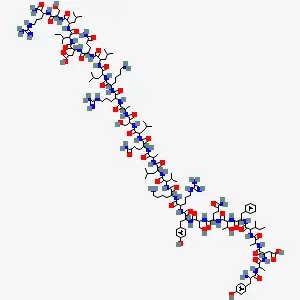
CJC-1295 without DAC, also referenced as CJC-1295 No DAC or Mod GRF 1-29, is a 29-amino-acid synthetic peptide analog supplied as a lyophilized research material. It is characterized by a tetra-substituted GRF 1-29 sequence and does not include the DAC moiety found in related variants. Product references commonly describe it by its DAC-free structure, molecular formula, molecular weight, and lyophilized form for laboratory documentation and analytical review.
CJC-1295 without DAC is also listed as CJC-1295 No DAC and Mod GRF 1-29 on supplier pages and reference materials. Core Peptides uses these names together on its product page, which makes them useful identifiers to include in a research-focused section.
Core Peptides describes CJC-1295 without DAC as a synthetic peptide derivative composed of 29 amino acids and presents it as a modified GRF (1-29) sequence. The page also notes that the without-DAC form is structurally distinct because it does not include the added Drug Affinity Complex used in some related variants.
In research discussions, this material is commonly framed in relation to GHRH-receptor-associated studies and laboratory signaling models. A product page can present that context in a neutral way by referring to receptor binding, signaling characterization, and assay readouts rather than outcome-driven language.
Core Peptides highlights several technical product signals that are useful for research readers, including lyophilized powder form, purity above 99%, and access points for Certificate of Analysis, HPLC, and Mass Spectrometry. Including this type of documentation language helps the section stay laboratory-focused and strengthens product-page relevance.
This material is presented as a research-use item intended for legitimate laboratory work and not as a consumer-facing product. The product page should maintain a research-first presentation focused on technical review, documentation access, and controlled laboratory workflows.
CJC-1295 without DAC is supplied as lyophilized powder and supported by technical documentation relevant to laboratory review. Available records may include Certificate of Analysis, HPLC, and Mass Spectrometry, supporting identity review, batch traceability, and laboratory recordkeeping.
Product access, ordering, and handling are subject to site terms, age-gating where applicable, and internal laboratory controls. This supports a controlled purchasing environment aligned with research-use positioning.
This material is supplied for in vitro and laboratory workflows only and is not intended for personal, household, or veterinary applications. The product page should keep this boundary clear throughout all technical and descriptive content.
Each batch is analytically verified and supported by a lot-specific Certificate of Analysis (COA). Use the COA portal to access available documentation by product and lot number. Documentation availability may vary by batch.
Store at -20°C for optimal long-term stability (up to 2 years). The lyophilized form is stable at room temperature for brief periods during shipping and handling.
Use immediately for best results. If storage is required, aliquot and store at -80°C. Use within 30 days. Avoid repeated freeze-thaw cycles which may degrade peptide integrity.
Products ship in insulated packaging with cold packs when ambient temperatures require it. Lyophilized peptides remain stable during standard transit times.
PubChem. CJC1295 Without DAC compound record. PubChem database entry
Martin B, Lopez de Maturana R, Brenneman R, et al. Class II G protein-coupled receptors and their ligands in neuronal function and protection. NeuroMolecular Medicine, 2005. Springer article
Loh HH, Law PY. Second Messengers. Cold Spring Harbor Perspectives in Biology, 2016. CSH Perspectives article
Teichman SL, et al. Prolonged stimulation of growth hormone and insulin-like growth factor I by CJC-1295, a long-acting analog of growth hormone-releasing hormone, in healthy adults. The Journal of Clinical Endocrinology & Metabolism, 2006. Journal page
Zhou F, et al. Structural basis for activation of the growth hormone-releasing hormone receptor. Nature Communications, 2020. Nature article
This product is intended for laboratory research use only (in vitro).
By purchasing this product, you confirm it will be used solely for legitimate research purposes.
Neither is universally “better.” DAC and no DAC are better thought of as different pharmacokinetic versions . FDA’s 2024 review treats CJC-1295 and CJC-1295 DAC as distinct active moieties, and the original CJC-1295 DAC work showed DAC was added to prolong exposure by binding to albumin. So with DAC is the longer-acting version; without DAC is the shorter-acting version. Which one is “better” depends on whether you want prolonged exposure or a shorter pulse, not on a clear superiority result.
Store at -20°C for up to 2 years. Stable at RT during shipping.
Use immediately or store aliquots at -80°C. Use within 30 days.
Every batch from Peptide Researches undergoes rigorous HPLC & Mass Spectrometry testing to ensure >99% purity and correct molecular structure verification.
This product is for laboratory research only. Not for human or animal consumption. Not intended to diagnose, treat, cure, or prevent any disease.
Discover · Topic hubs
Open a dedicated hub for long-form context and citations. Checkout stays on the main product page.