Laboratory preservation protocols
Lyophilized research materials stay analytically useful when storage temperature, light exposure, and reconstitution follow your lot certificate of analysis and institutional SOPs—not generic web copy.
GHRH-axis research peptide
A research-grade peptide used in controlled models to investigate pulsatile growth-hormone axis signaling and downstream metabolic biology. This page is informational (RUO) and does not describe clinical use, dosing, or outcomes.
Current value
$49.00 USD
Certified purity
CoA-verified release testing
CJC-1295 without DAC is a research-grade, lyophilized peptide supplied for controlled laboratory studies involving GHRH-related receptor signaling, assay development, and peptide characterization. Lot-specific COA access and supporting analytical documentation are available through the COA portal. For laboratory research use only. Not for use in humans or animals.
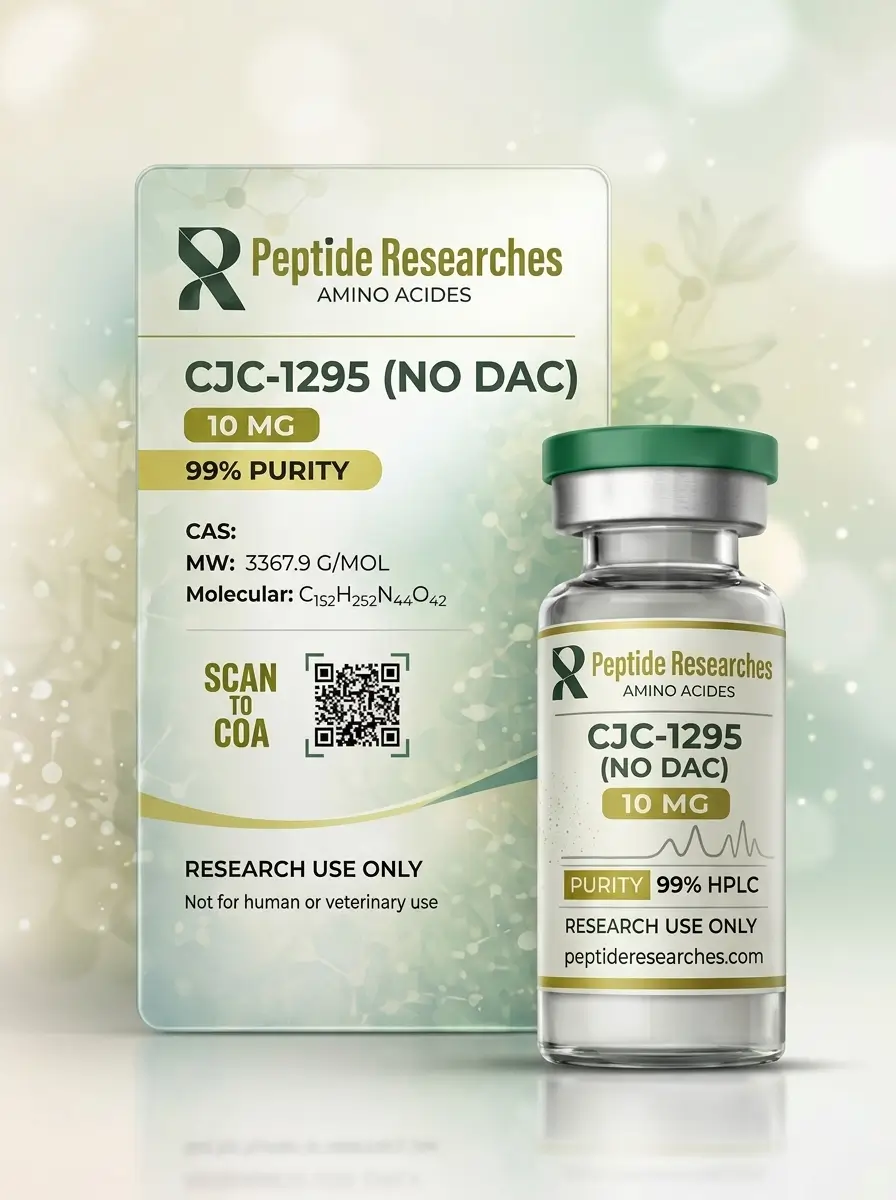
Studio product image of Peptide Researches CJC-1295 No DAC 10 MG featuring the branded box, QR code, purity details, and vial for laboratory research catalog pages.

CoA-verified release testing
Structure & identity
Key identity fields aligned with the product page; always verify against your batch CoA.
Molecular formula
Identity per product specifications — confirm on your lot CoA.
Peptide class
GHRH analogue (no DAC conjugation)
Signal profile
Short-acting / pulsatile-window studies
Typical strengths
5mg and 10mg formats
Without DAC conjugation, CJC-1295 is generally framed in research as a shorter-acting GHRH analogue that supports episodic receptor stimulation windows rather than prolonged exposure profiles.
Programs use this profile to compare time-course effects across endocrine signaling models, including GH pulse timing, downstream marker behavior, and pathway-level crosstalk under controlled assay conditions.
Treat all mechanistic assumptions as hypothesis-level until validated in your own model system with suitable controls, assay calibration, and lot-specific documentation.

Analytical verification
Release workflows should include lot-specific analytical documentation (for example HPLC purity data and orthogonal identity checks where required by your quality system). Request the Certificate of Analysis for your exact batch and verify acceptance criteria before integrating material into regulated workflows.
Download CoA (PDF)Lyophilized research materials stay analytically useful when storage temperature, light exposure, and reconstitution follow your lot certificate of analysis and institutional SOPs—not generic web copy.
Store lyophilized material frozen per CoA guidance (commonly −20 °C or colder). After reconstitution, keep refrigerated with minimized hold times and strict chain-of-custody records.
Batch-specific guidanceLimit exposure to bright light, humidity, and repeated temperature cycling. Use sealed storage, desiccation discipline, and light-protective handling where required by your SOP.
Batch-specific guidanceReconstitute with appropriate sterile lab diluent in controlled environments, mixing gently along the vial wall. Aliquot promptly to reduce freeze-thaw events that can reduce peptide integrity.
Batch-specific guidanceFor laboratory research use only (RUO). Not for human consumption, medical, veterinary, or diagnostic use. This content is educational and does not provide medical claims, treatment guidance, or dosing instructions. Always follow institutional protocols, local regulations, and lot-specific CoA documentation.
These references support research literacy around endocrine signaling, peptide handling discipline, and regulatory context. Always verify technical claims against your lot-specific documentation.
Structured for FAQ rich results. Confirm all material claims against your lot CoA.
Access live pricing, quantity bundles, variant selection, and detailed fulfillment policies.
All research-grade materials ship with batch-specific CoA documentation.
Ships worldwide • Research use only • Secure checkout